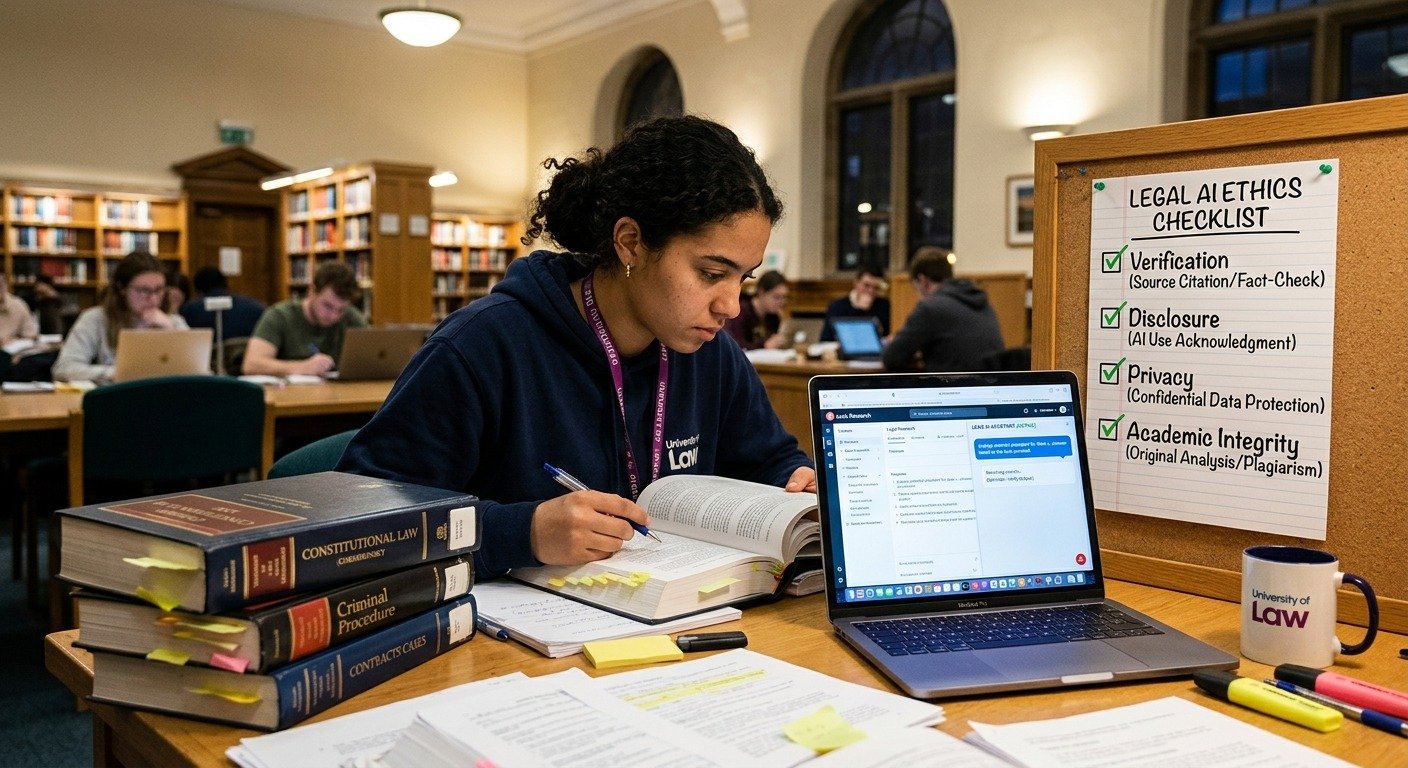
US law schools are taking sharply different approaches to generative AI. Some are restricting laptops and AI tools to protect foundational legal reasoning, while others are adding AI courses and permitting limited, disclosed use.
For students, the practical lesson is simple: never assume that an AI practice allowed in one class is permitted in another. Check each syllabus, protect confidential information, document permitted use, and remain capable of defending every argument and citation yourself.
How Are Law Schools Regulating AI?
At least a dozen US law schools revised their technology or artificial intelligence policies during the summer of 2026, according to Reuters reporting published on September 21.
The resulting policies do not follow a single national model.
The University of Chicago has adopted strict classroom technology restrictions intended to emphasize traditional legal analysis and active participation. Columbia and the University of Michigan have taken more balanced approaches that permit certain uses of AI. The University of California, Berkeley introduced restrictive general rules while allowing individual instructors some flexibility.
Suffolk University has compiled policies from 180 law schools, illustrating how widely institutional approaches now vary.
One area has greater agreement: generative AI is generally prohibited during examinations. Schools want assessments to measure a student’s own legal knowledge, reasoning, and writing.
Why Are Policies So Different?
Law schools are trying to protect two legitimate educational goals that can pull in opposite directions.
Students need to develop independent skills in reading cases, identifying issues, applying precedent, and constructing arguments. If an AI system performs that work too early, students may produce polished answers without understanding the law behind them.
At the same time, legal employers increasingly use AI for research, document review, contract analysis, drafting, and administrative work. Graduates who have never used these systems may enter the profession without an important practical skill.
The emerging debate is therefore not simply whether AI is good or bad. It is about when students should use it, what tasks it should perform, and how its contribution should be disclosed.
What Uses of AI May Be Allowed?
Permission depends on the school, professor, assignment, and tool. When expressly authorized, students may be able to use AI for supporting tasks.
Creating Practice Questions
A student could ask an AI assistant to generate hypothetical questions about negligence, contracts, or constitutional law. The student should then answer the questions independently and verify whether the scenarios accurately reflect the relevant legal principles.
Testing an Argument
AI can act as a critical reader:
Review this argument and identify missing counterarguments. Do not rewrite it or add legal authorities.
This keeps the student responsible for the analysis while using the tool to expose possible weaknesses.
Improving Organization
Some instructors may allow AI to suggest headings or identify unclear transitions after a student has completed an original draft.
Permission to improve structure does not necessarily include permission to generate the underlying argument.
Learning Legal Technology
Students enrolled in approved legal-technology courses may examine how AI systems retrieve information, generate text, make errors, and affect professional responsibilities.
These examples describe possible permitted uses. They are not universal permissions.
What Should Law Students Avoid?
Do Not Invent or Trust Citations
Generative AI can produce cases, quotations, docket numbers, or legal propositions that appear credible but are false.
Every authority must be located in a reliable legal database and read in context. Students should confirm that the case exists, remains valid, and actually supports the stated proposition.
Do Not Upload Confidential Material
Students working in clinics, internships, or law firms may encounter privileged or sensitive information. They should not paste client communications, medical records, unpublished case strategies, personal data, or protected documents into a public AI tool.
Removing a client’s name may not make a document safe if the remaining facts reveal the person’s identity.
Do Not Hide AI Assistance
If a course requires disclosure, state which tool was used, what task it performed, and how the output was checked.
Submitting AI-generated analysis as entirely original work may violate academic-integrity rules even when the final text contains no obvious copying.
Do Not Submit Work You Cannot Explain
A student should be able to defend every legal conclusion, citation, and strategic choice. If an answer cannot survive follow-up questions without help from the tool, the student has not completed the intellectual work required.
A Five-Step AI Checklist for Law Students
Before using generative AI for an academic task:
- Read the school policy, syllabus, and assignment instructions.
- Ask the instructor when the permitted boundary is unclear.
- Remove confidential, personal, and privileged information.
- Independently verify every legal claim and authority.
- Keep a record of prompts, outputs, revisions, and required disclosures.
Saving this record can help students explain their process if questions arise later.
What Does This Mean for Legal Education?
The current policy differences suggest that legal education is still experimenting with the right balance.
It is reasonable to expect more schools to combine protected, AI-free exercises with supervised technology instruction. That is an inference from current policy changes, not a confirmed nationwide standard.
Traditional legal reasoning will remain essential because AI output can be incomplete or incorrect. AI literacy will also matter because future lawyers must understand the tools used by clients, courts, firms, and opposing counsel.
The strongest graduate will not be the person who refuses every new tool or accepts every generated answer. It will be the person who knows when AI is appropriate, verifies its work, protects sensitive information, and remains accountable for the result.
Frequently Asked Questions
Can law students use ChatGPT for assignments?
Sometimes. Permission depends on the school, professor, and assignment. Students should never assume that general access means academic use is allowed.
Is AI permitted during law school exams?
Reuters reports that law schools generally prohibit generative AI during examinations. Students must follow the specific rules issued by their institution.
Can AI conduct reliable legal research?
AI can help identify topics or search terms, but it may fabricate or misrepresent authorities. Every case, quotation, and legal proposition requires independent verification.
Should students disclose AI use?
Yes, whenever the instructor or institution requires it. Even without a formal rule, asking before using AI is safer than assuming permission.
Will future lawyers need AI skills?
Many legal employers increasingly expect technology fluency. Students should learn both how to use AI and how to recognize its privacy, accuracy, and ethical risks.
Conclusion
Law school AI policies in 2026 reflect a profession adapting to technology without abandoning independent reasoning. Students can prepare by learning the rules of each course, protecting confidential information, verifying sources, and using AI as a supervised aid rather than a substitute for judgment.
Follow Tech Ketchups for practical coverage of artificial intelligence, education, careers, robotics, gaming, and emerging technology. We are human and can make mistake, so please contact us if you find anything like that!