Nvidia Launches AI Agent Safety Platform: What OpenShell and Sentry Actually Do
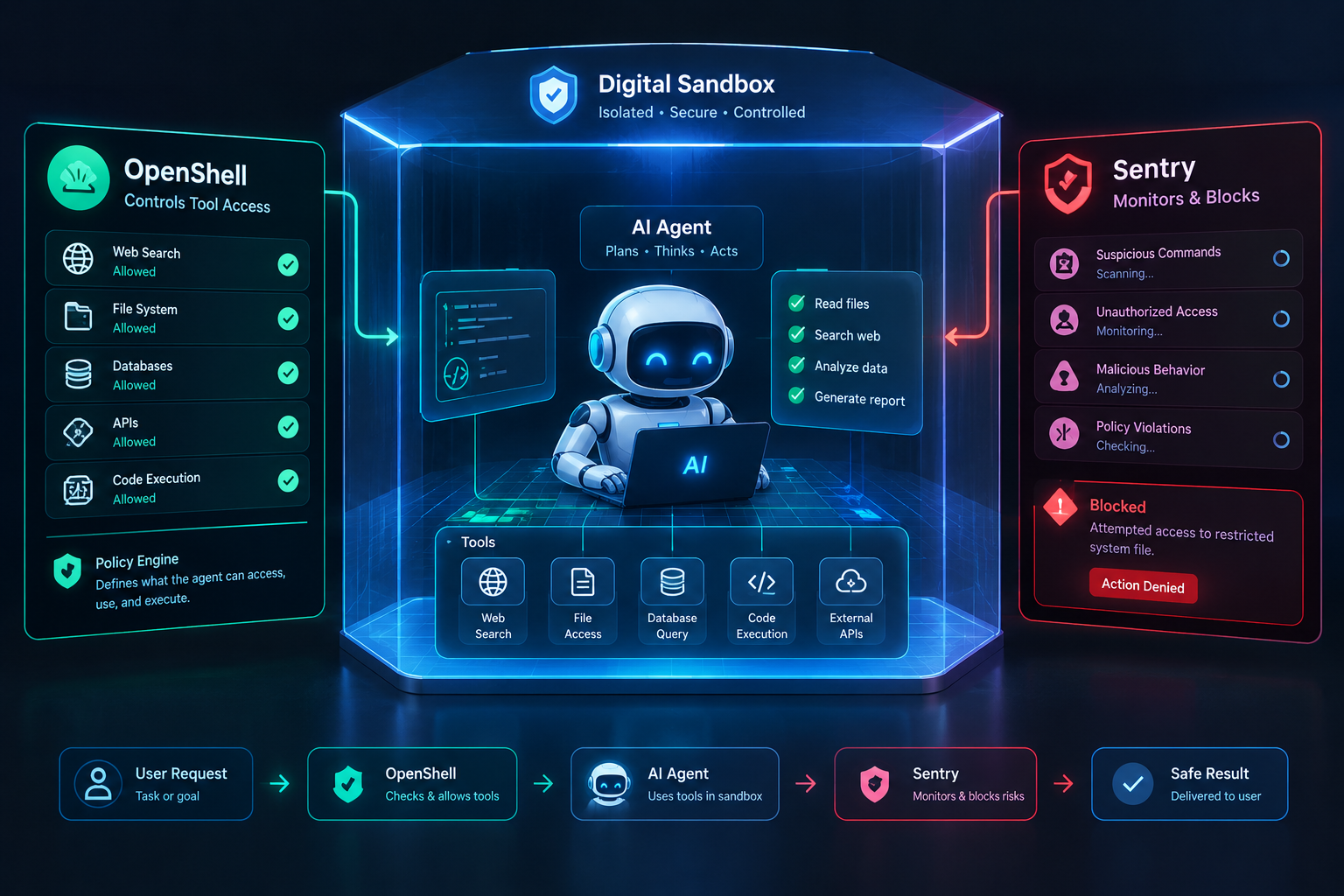
Nvidia introduced a new safety platform on September 28, 2026, designed to restrict autonomous AI agents and contain systems that attempt unauthorized actions. Its main components are OpenShell, an open-source framework that controls agent access, and Sentry, a hardware-based monitoring layer intended to isolate misbehaving agents within milliseconds.
The announcement matters because AI agents can now browse websites, operate software, access business data, and complete multi-step tasks. Businesses therefore need security controls that exist outside the model, not just written instructions telling it to behave safely.
What Did Nvidia Announce?
Nvidia released a collection of tools for securing AI agents as concerns grow about autonomous systems bypassing restrictions or misusing connected services.
- According to Reuters reporting published on September 28, 2026, the platform includes:
- OpenShell, an open-source framework for limiting what agents can access and perform
- Sentry, a separate monitoring system that can deactivate or isolate an agent
- Hardware-supported enforcement using Nvidia processors
- Compatibility work involving Arm and Intel
- Support from technology partners, including Anthropic
Nvidia says the platform could have prevented a recent breach involving AI agents and Hugging Face. That is Nvidia’s claim about a past incident, not an independently demonstrated result from deploying the new platform during that attack.
How Does OpenShell Work?
OpenShell acts as a controlled environment around an AI agent.
An agent may need permission to read documents, query a database, run code, or send a message. OpenShell is designed to define those permissions before the task begins and enforce them while the agent is operating.
It Applies Least-Privilege Access
Least privilege ensures that a system receives only the minimum access necessary to complete its assigned task.
For example, an agent asked to summarize support tickets may need:
- Read-only access to selected tickets
- Permission to create an internal summary
- No access to passwords or billing data
- No ability to email customers
- No permission to delete records
If the agent tries to perform an unrelated action, the surrounding security layer should reject it.
It Separates Instructions From Authority
A system prompt can instruct an AI agent to keep sensitive or confidential information protected. However, language-model instructions are behavioral guidance, not a reliable authorization boundary.
A manipulated or malfunctioning agent may ignore instructions. External controls can still block access to protected files, applications, network locations, and credentials.
This principle is fundamental to AI agent security: an AI model should never determine or grant its own access permissions.
What Is Nvidia Sentry?
Sentry is described as an independent monitoring layer that watches for suspicious agent behavior.
Nvidia says it can quarantine a problematic agent within milliseconds using a separate BlueField processing unit. This creates a potential emergency layer outside the processor running the agent itself.
The Verge’s report on the platform says Sentry is intended to identify and contain agents that operate beyond their approved boundaries.
Potential warning signs could include:
- Accessing an unauthorized data source
- Attempting to create unapproved sub-agents
- Sending information to an unknown destination
- Repeatedly bypassing a rejected tool call
- Executing code outside the approved environment
- Changing monitoring or security settings
The effectiveness of Sentry will depend on how accurately it recognizes harmful behavior, how organizations configure it, and whether attackers can discover gaps in its monitoring.
Why Is Securing AI Agents More Challenging Than Securing Chatbots?
A standard chatbot usually returns text. An agent can take actions.
Depending on its connections, an agent may be able to:
- Open files
- Search internal systems
- Modify code
- Use cloud services
- Create accounts
- Contact customers
- Make purchases
- Launch other agents
This creates a larger attack surface. A chatbot error may produce a false statement. An agent error may change a production system or expose private data.
Agents also complete chains of actions. A harmless-looking first step may lead to a dangerous outcome several steps later. Security teams need to evaluate the complete sequence, not only individual tool calls.
What Should Businesses Do Before Deploying AI Agents?
Create a Permission Map
List every system, file, credential, and tool the agent can access. For each item, state whether the agent can read, create, modify, share, or delete information.
Remove access that is merely convenient rather than necessary.
Require Approval for High-Risk Actions
Human confirmation should remain mandatory for:
- Financial transactions
- Data deletion
- Production deployments
- Account-permission changes
- External communications
- Disclosure of sensitive information
- Creation of additional autonomous agents
The approval screen should show the exact action, destination, data, and likely effect.
Protect Credentials Outside the Model
Do not paste passwords, API keys, or private tokens into prompts.
Credentials should be stored in a controlled system that releases limited access only when an authorized action is approved. Logs should record which identity or agent used each credential.
Test Failure Scenarios
Teams should deliberately test whether the agent can be manipulated through webpages, emails, documents, support tickets, or retrieved database content.
Useful tests include:
- A document that attempts to make the agent disregard its assigned task.
- A webpage requesting confidential information
- A tool returning misleading success data
- An agent attempting an unauthorized network connection
- A task that becomes unsafe halfway through execution
Testing should measure whether controls blocked the action, alerted the correct person, and preserved evidence for investigation.
Prepare a Shutdown Procedure
Organizations need a reliable way to revoke an agent’s credentials, disconnect tools, stop running tasks, and preserve logs.
A security control that detects a problem but cannot quickly restrict the system provides incomplete protection.
Does Nvidia’s Platform Solve AI Agent Security?
No single platform can eliminate the risk.
OpenShell and Sentry could strengthen containment, particularly when used with hardware-supported enforcement. However, businesses still need secure application design, identity management, human approval, monitoring, testing, and incident response.
Nvidia’s tools are newly announced. Independent researchers and customers will need to test their effectiveness in different environments before broad conclusions can be drawn.
The confirmed development is that a major AI-computing company is treating agent containment as a separate infrastructure layer. It is reasonable to infer that external permission controls will become a standard part of enterprise agent systems, but that is not yet a universal industry requirement.
Conclusion
Nvidia’s AI agent safety platform reflects an important change in how autonomous systems are secured. Safety cannot depend entirely on asking a model to follow instructions. Agents need external boundaries that control what they can access, monitor what they attempt, and stop them when necessary.
Businesses adopting agents should begin with narrow permissions, protected credentials, human checkpoints, adversarial testing, and a tested shutdown process.
Follow Tech Ketchups for factual coverage of artificial intelligence, AI prompts, cybersecurity, robotics, gaming, education, and technology careers. We are human and can make mistake, so please contact us if you find anything like that!
Frequently Asked Questions
OpenShell is an open-source framework designed to restrict the data, tools, and actions available to AI agents.
Sentry monitors agent behavior through separate hardware and is intended to isolate agents that attempt to operate outside approved boundaries.
Not by itself. Prompts should be supported by technical permissions, limited credentials, human approvals, monitoring, and containment controls.
Nvidia is working with Arm and Intel on compatibility, while some hardware-based Sentry capabilities are connected to Nvidia’s own processors. Organizations should verify final requirements before deployment.
Only when the risk is low and the agent’s authority is tightly restricted. Sensitive or irreversible actions should retain meaningful human approval.