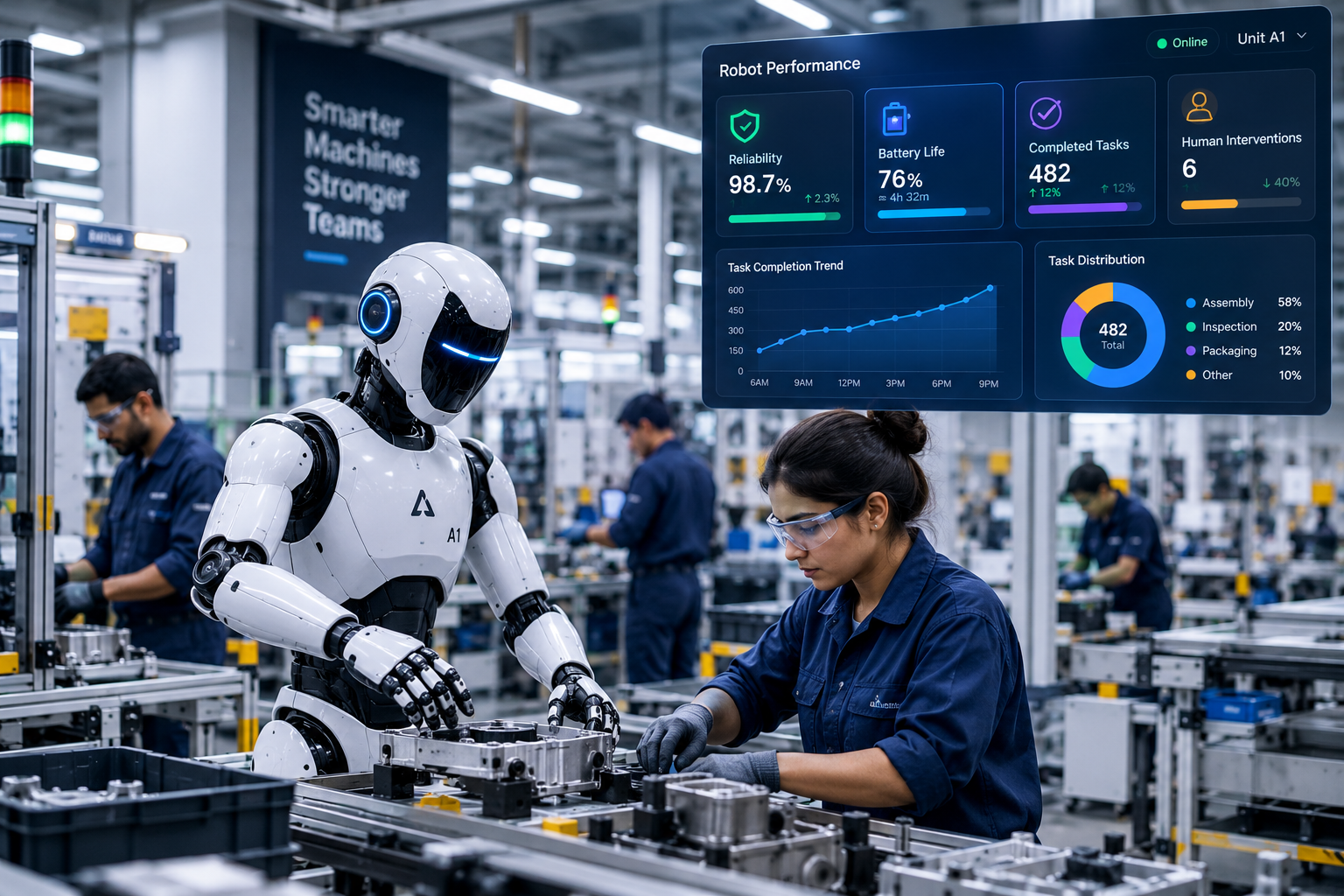
Approximately 7,000 humanoid robots were sold worldwide in 2025 for industrial and professional-service applications, according to the International Federation of Robotics. It is the first time the organization has included humanoids in its global robot statistics.
The figure confirms that commercial adoption has begun, but it also provides an important reality check. Most humanoids are still being used for research, artificial-intelligence development, and limited factory trials rather than replacing large numbers of workers.
What Counts as a Humanoid Robot?
The International Federation of Robotics, commonly called IFR, defines humanoids as autonomous robots with a human-like appearance that can operate in environments designed for people.
The International Federation of Robotics, commonly called IFR, defines humanoids as autonomous robots with a human-like appearance that can operate in environments designed for people.
Humanoids are part of a wider robotics industry that also includes:
- Fixed industrial robot arms
- Warehouse mobile robots
- Cleaning robots
- Medical systems
- Agricultural robots
- Inspection robots
- Delivery machines
The 7,000-unit figure covers industrial and professional-service humanoids. It excludes consumer, military, and medical robots.
How Significant Are 7,000 Sales?
The number is meaningful because it establishes an early commercial baseline. However, humanoids remain a very small part of the global robotics market.
Reuters reported on September 21, 2026 that approximately 542,000 conventional industrial robots and 199,000 professional-service robots were installed during 2024.
Compared with those established categories, 7,000 humanoid sales are modest.
Many units were purchased by laboratories and companies that need machines for AI training, software development, and experiments. A research sale does not necessarily mean that the robot is completing productive work during a full factory shift.
The confirmed conclusion is that a humanoid market now exists. Claims that mass workplace replacement has already arrived would go beyond the available evidence.
Where Are Humanoid Robots Being Used?
Research and AI Training
Research institutions use humanoids to study movement, perception, object manipulation, language understanding, and human-robot interaction.
Developers need real-world data showing how a robot should grasp objects, recover from mistakes, navigate crowded spaces, and respond to instructions.
Automotive Manufacturing
Vehicle manufacturers are among the earliest commercial testers. Factories contain repetitive material-handling and component-sequencing tasks that can be measured in controlled environments.
Companies can monitor completion rates, safety incidents, battery life, maintenance, and operating costs before expanding a pilot.
Professional Demonstrations
Some humanoids are used at exhibitions, customer-service locations, and technology demonstrations. These deployments can improve visibility, but they should not be confused with independent, general-purpose labor.
A robot completing a scripted presentation is different from one handling unpredictable work for eight hours.
Warehouses and Logistics
Potential applications include moving containers, sorting objects, loading shelves, and delivering parts to employees.
Humanoid shapes may be useful in facilities originally designed for human workers. However, a specialized warehouse robot may remain faster or cheaper when the task does not require human-like movement.
Why Is Large-Scale Adoption Difficult?
Reliability Must Improve
A factory needs consistent performance across thousands of repeated actions. A robot that succeeds nine times out of ten may still create unacceptable delays or safety risks.
Real workplaces contain damaged objects, unexpected obstacles, changing lighting, spills, noise, and people who behave unpredictably.
Batteries Limit Working Time
Walking, balancing, sensing, computing, and lifting require substantial energy. A robot must either operate long enough between charges or use a battery-swapping system that does not interrupt production.
Hands Remain a Major Challenge
Human hands can rapidly adjust grip, pressure, position, and finger movement. Robots still struggle with flexible materials, small objects, tangled cables, irregular packaging, and unfamiliar tools.
Economics Must Beat Existing Alternatives
Businesses will compare a humanoid with human labor, fixed automation, mobile robots, and redesigned production processes.
A human-shaped machine is not automatically the best option. It becomes valuable when flexibility across several tasks justifies its purchase, integration, energy, supervision, and maintenance costs.
AI Errors Have Physical Consequences
A chatbot mistake may produce an inaccurate sentence. A robot mistake can drop an object, damage equipment, or injure someone.
This makes permission controls, emergency stops, force limits, testing, and human supervision essential.
Are Humanoid Sales Expected to Grow?
Some analysts expect rapid expansion. Reuters cited a Bank of America Global Research estimate of 90,000 humanoid shipments in 2026 and 1.2 million in 2030.
These figures are forecasts, not confirmed sales. Actual growth will depend on reliability, prices, regulation, manufacturing capacity, and customer demand.
Investor expectations are also facing greater scrutiny. Reuters reported separately that Chinese regulators were applying greater caution to humanoid-robot listings amid concerns about high valuations and the commercial quality of some revenue.
The direction of travel points toward growth, but the speed remains uncertain.
Can law students use ChatGPT for assignments?
Humanoids may automate selected repetitive, dangerous, or physically demanding duties. The current sales figures do not support the conclusion that entire workforces are about to disappear.
Early deployments are more likely to place robots alongside employees. People may handle exceptions, quality control, repair, safety, planning, and communication while machines perform predictable physical actions.
Workers can prepare by developing adjacent skills:
- Robot operation and maintenance
- Industrial automation
- Machine vision
- Workplace safety
- Programmable logic controllers
- Data analysis
- AI-system monitoring
- Process improvement
The goal is not for every worker to become a robotics engineer. It is to understand how automation affects an existing profession and learn to supervise, maintain, or improve the new workflow.
What Should Businesses Measure During a Pilot?
A company testing a humanoid should measure practical performance rather than relying on demonstration videos.
- Important metrics include:
- Successful task completion rate
- Operating hours between failures
- Human interventions per shift
- Energy use and charging time
- Maintenance cost
- Safety incidents and near misses
- Integration time
- Cost per completed task
A pilot should also compare the humanoid with specialized automation and process redesign. The most visually impressive option may not deliver the best return.
Conclusion
The first global humanoid sales tally shows that the technology is moving from demonstrations toward commercial testing. It also reveals how early the market remains.
The next stage will depend on whether humanoids can deliver safe, reliable, and affordable work outside controlled demonstrations. Businesses should focus on measurable productivity, while workers should build skills that connect their existing experience with automation.
Follow Tech Ketchups for factual updates on robotics, artificial intelligence, gaming, education, technology careers, and emerging innovation. We are human and can make mistake, so please contact us if you find anything like that!
Frequently Asked Questions
The IFR counted approximately 7,000 worldwide for industrial and professional-service applications.
No. Many were purchased for research, AI development, and limited commercial trials.
Not under the IFR definition. A humanoid may use wheels while maintaining a human-like form and operating autonomously in human environments.
They may automate selected tasks, but current deployments remain limited. Large-scale replacement is not supported by the latest sales data.
A humanoid may work in spaces, doorways, workstations, and processes designed for people. Traditional automation may still be better for fixed, repetitive tasks.