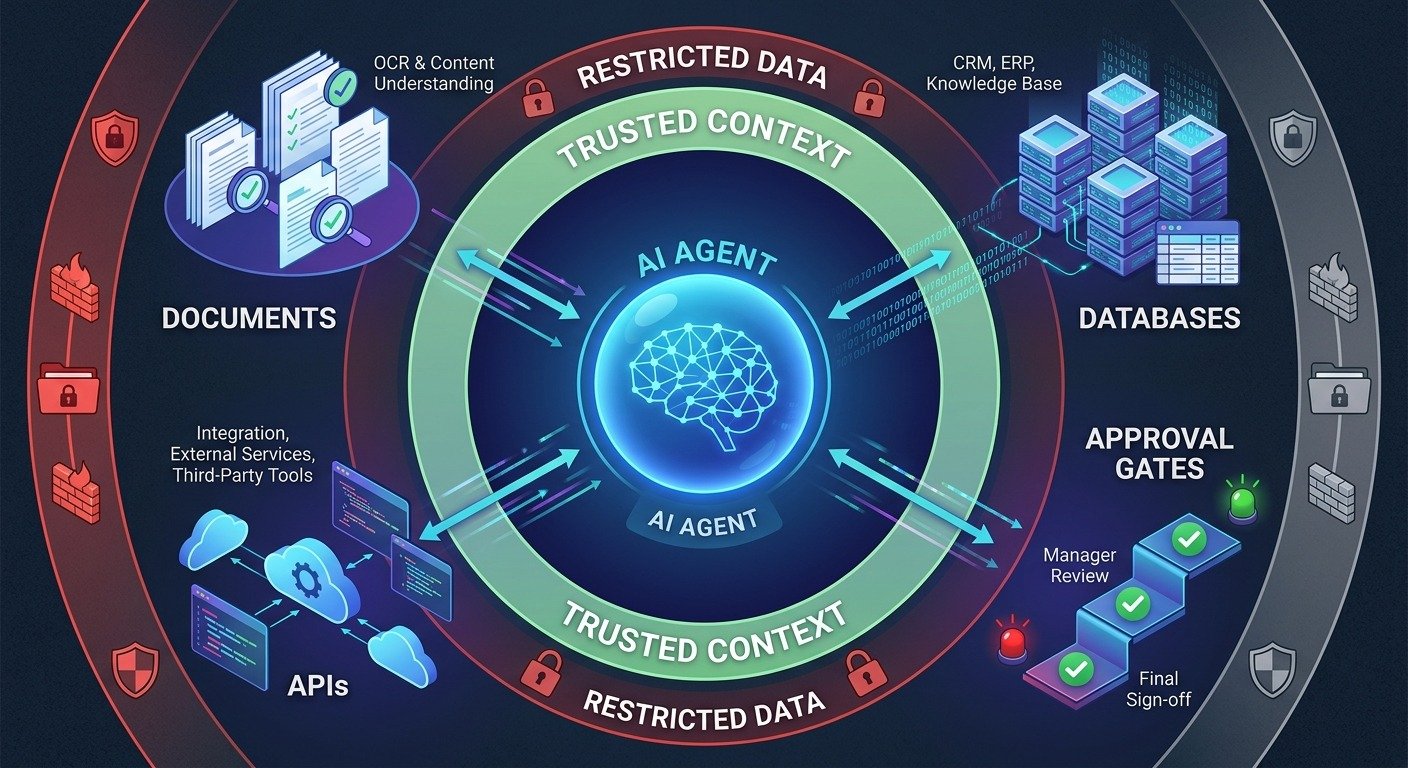
Context engineering is becoming one of the most important AI skills in 2026 because reliable agents need more than a clever prompt. They need the right data, tools, permissions, instructions, history, and business rules at the moment a decision is made.
The direct answer is simple: prompt engineering tells an AI what to do, while context engineering designs the full environment that helps an AI do it accurately and safely. This matters as companies move from one-off chatbot experiments to agents that work across software, documents, customer systems, and engineering workflows.
What Is Context Engineering?
Prompt engineering focuses on the wording of a request. For example:
Summarize this customer complaint in five bullet points.
Question about Context engineering:
- Which customer record should the agent read?
- Which policy version should it follow?
- What tools may it use?
- What information must remain hidden?
- What previous decisions matter?
- When should it ask for approval?
- How should the result be checked?
In practice, context engineering combines retrieval, memory, tool access, permissions, policies, and workflow design.
A useful way to think about it is this: the prompt is the instruction, but the context is the operating environment.
Why This Trend Is Growing Now
OpenAI’s Frontier platform is designed to help enterprises build AI agents with shared context, permissions, onboarding, and feedback loops. OpenAI says many agent projects fail because information is scattered across systems and integrations are built as isolated one-off efforts. OpenAI Frontier announcement
Atlassian is also making a same like move in software developing. Its September 10, 2026 announcement introduced shared context for coding agents and controls that determine which Jira and Confluence spaces agents can access. Atlassian also described governed “agent loops” that can move from a backlog item to a tested pull request. Atlassian governed agent loops announcement
These developments reflect a broader industry shift, as businesses increasingly focus on more than just selecting the right AI model.
Prompt Engineering vs Context Engineering
Prompt Engineering
Prompt engineering is still useful for:
- Clear instructions
- Output formatting
- Role definition
- Examples
- Constraints
- Tone and audience
It is often enough for drafting, brainstorming, tutoring, and simple analysis.
Context Engineering
Context engineering becomes increasingly important when an AI system needs to manage complex tasks, maintain relevant information, and deliver accurate, consistent results.
- Work across multiple applications
- Use private company information
- Follow changing policies
- Maintain task history
- Call tools or APIs
- Make decisions with business consequences
- Hand work from one agent to another
For example, a sales agent should not rely on a generic prompt such as “qualify this lead.” It needs the company’s qualification rules, current pricing, territory boundaries, account history, approved messaging, and permission to update only the right fields.
The Core Parts of a Reliable AI Context
Relevant Information
The agent should receive the information needed for the task, not an uncontrolled dump of every available document.
Too little context creates weak answers. Excessive irrelevant context increases costs, causes confusion, and raises the risk of relying on outdated information.
Fresh and Trusted Sources
AI agents must prioritize authoritative sources, ensuring that up-to-date information, such as a current pricing sheet, takes precedence over outdated materials like old presentations. A published policy should outrank an informal chat message.
Teams should label documents by owner, date, status, and approval level.
Permissions and Boundaries
An agent should only access the systems and records required for its role.
A support agent may read product documentation and ticket history, but it should not automatically edit billing records or export customer data.
Memory With Expiration
Long-term memory can help an agent maintain continuity, but not every detail should be stored forever.
Businesses should define what can be remembered, how long it remains valid, and how a user can correct or delete it.
Provenance and Auditability
Important outputs should include clear source references to ensure transparency, traceability, and reliability. This helps employees verify claims and investigate mistakes.
For high-impact work, an audit trail should capture the user request, retrieved context, tools used, approvals, and final action.
How Businesses Can Start
Begin With One Repetitive Workflow
Choose a process that is frequent, measurable, and easy to review.
Examples include:
- Internal knowledge search
- Ticket classification
- Meeting follow-up
- Code documentation
- Report preparation
- Backlog triage
Avoid starting with irreversible actions such as financial transfers, legal submissions, or automatic customer decisions
Build a Context Map
List the information sources, systems, policies, and people involved in the workflow.
Then mark:
- The source of truth
- Sensitive data
- Approval points
- Allowed tools
- Failure conditions
- Escalation paths
This map often exposes problems before any model is selected.
Measure More Than Accuracy
A useful agent should be evaluated on:
- Task completion rate
- Factual accuracy
- Citation or source quality
- Rework required
- Escalations to humans
- Cost per task
- Response time
- Permission violations
An agent that sounds convincing but creates expensive rework is not delivering business value.
Implications for Students and Job Seekers
Context engineering creates a practical career path for people who understand both AI and business operations.
Useful skills include:
- Retrieval augmented generation
- Document chunking and metadata
- API integration
- Workflow mapping
- Access control
- Evaluation design
- Data governance
- Prompt and instruction writing
- Monitoring and observability
A strong portfolio project could build a small company knowledge assistant that uses approved documents, cites its sources, blocks restricted files, and asks for human review when confidence is low.
That project demonstrates more than prompt creativity. It shows system thinking.
Frequently Asked Questions
Not completely. Prompt engineering remains useful, but context engineering is becoming more important for agents that operate across real business systems.
It is the design of the information, tools, permissions, memory, and rules an AI agent receives while completing a task.
Without reliable context, agents may use outdated documents, miss important constraints, access the wrong systems, or produce confident but incorrect results.
Yes. A small business can begin with a narrow workflow, a small set of approved documents, limited permissions, and clear human review.
Start with prompt basics, retrieval, APIs, data organization, access control, and simple evaluation methods. Understanding the workflow is as important as understanding the model.
Conclusion
The next phase of enterprise AI will be shaped less by isolated prompts and more by the quality of the environment surrounding the agent. OpenAI’s Frontier platform and Atlassian’s governed engineering workflows both show that shared context, permissions, and auditability are becoming central to practical AI deployment. OpenAI Frontier announcement Atlassian governed agent loops announcement
For businesses, the goal should be to give agents the right information and authority, not unlimited access. For learners and job seekers, context engineering offers a valuable way to stand out by combining AI skills with workflow design, security, and judgment.
Follow Tech Ketchups for practical coverage of artificial intelligence, education, careers, robotics, gaming, and emerging technology. We are human and can make mistake, so please contact us if you find anything like that!