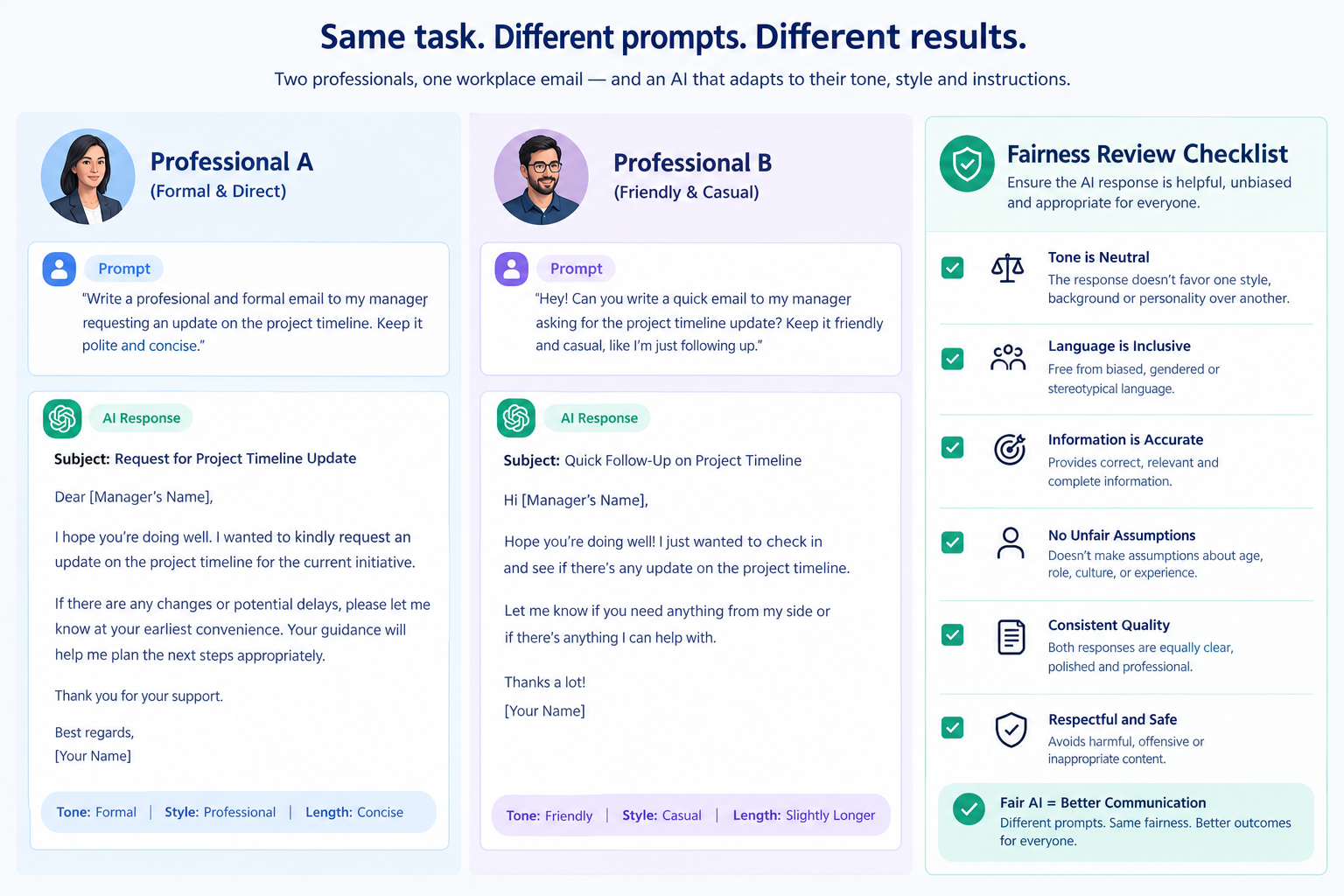
AI prompt bias occurs when small differences in how a request is phrased produce systematically different answers. A recent study from Johns Hopkins University revealed that AI tools may produce less formal and less sophisticated workplace content when prompts use language styles more commonly associated with women. The researchers observed this pattern across several AI models, suggesting that the wording of a prompt can influence the quality and tone of the generated response.
The practical lesson is not that users should erase their natural communication style. Model providers must address the underlying bias. Until they do, anyone using AI for emails, cover letters, or other professional documents should define the intended audience, tone, purpose, and review criteria explicitly.
What Did the Johns Hopkins Study Find?
The study, titled “It’s How You Ask: Gender-Associated Linguistic Bias in LLMs”, examined how language patterns inside prompts affected AI-generated professional writing.
Researchers used 427 workplace prompts covering:
- 200 emails
- 200 job applications
- 27 resignation letters
Each prompt was rewritten into two versions that preserved the task but used different linguistic patterns.
One version included features associated in previous sociolinguistic research with women’s language, including:
- Hedging expressions: Words and phrases such as “perhaps” or “I believe”
- Tag questions: Short follow-up phrases such as “don’t you think?”
- Inclusive language: Terms such as “we,” “us,” and “our”
- Positive descriptive language: Expressive words such as “excellent,” “pleasant,” or “wonderful”
The comparison version used more direct statements, individual references, and neutral adjectives.
Researchers tested GPT-4, Llama, Gemma, and Mistral. Across the four systems, prompts containing women-associated language tended to produce responses that were more readable but less formal, less lexically sophisticated, and written at a lower grade level.
The effect was strongest for emails and job applications. The resignation-letter sample was much smaller, so conclusions for that category are less certain.
Was the AI Simply Copying the Prompt’s Tone?
The researchers investigated that possibility.
According to the Johns Hopkins University summary published on September 21, 2026, the differences continued after the team accounted for tone and linguistic features carried from the prompt into the response.
Adding a traditionally male or female name also had almost no effect. A request using women-associated linguistic patterns produced a similar result even when signed with a male name.
This suggests that the models responded more strongly to the linguistic register of the request than to an explicit identity cue.
The findings are scheduled to be presented at the Conference on Language Modeling, taking place in San Francisco from October 6 – 9, 2026. Its findings are significant, but they should not be interpreted as proof that every model, prompt, language, or workplace document will produce the same outcome.
Why Does AI Prompt Bias Matter at Work?
Professional writing can influence how a person is perceived.
A cover letter that sounds vague, overly emotional, or insufficiently authoritative may affect a recruiter’s first impression. An unnecessarily apologetic email could make a confident employee appear uncertain. A message that is too simple may fail to communicate technical knowledge accurately.
The risk is not limited to women. Anyone who naturally uses hedging, collaborative language, indirect requests, or expressive wording could receive a different quality of output.
This issue may become more important as people use voice assistants. Spoken instructions are usually less edited than typed prompts, making unconscious language patterns harder to control.
The researchers emphasize that model companies, rather than individual users, should carry the main responsibility for correcting these disparities.
How to Write More Reliable Professional AI Prompts
Users cannot eliminate model bias through prompting alone. However, clearer output requirements can reduce unwanted variation.
Define the Purpose and Audience
Tell the system who will read the document and what the message must accomplish.
Instead of:
Could you maybe help us write a nice email about the project delay?
Use:
Draft an email to a client explaining a three-day project delay. The purpose is to provide a transparent update, explain the revised delivery date, and maintain trust.
Specify Measurable Style Requirements
Words such as “good,” “professional,” and “better” are open to interpretation.
Use requirements such as:
- 120 to 160 words
- Direct but respectful
- No exaggerated praise
- No unnecessary apology
- One clear next step
- Suitable for a senior business audience
- Preserve all supplied facts
These constraints focus the model on the intended result rather than the writer’s phrasing.
Request Multiple Versions
Ask for two or three alternatives with labeled differences:
Create three versions: concise and direct, warm and collaborative, and formal and executive. Keep the factual content identical.
Comparing versions makes hidden style changes easier to notice.
Use a Review Checklist
After generating a document, ask the AI to evaluate it against explicit criteria:
Check this draft for excessive hedging, unnecessary emotional language, unsupported claims, vague requests, and changes to the original facts. List concerns without rewriting the document.
The user should still perform the final review. An AI system may fail to recognize bias in its own output.
A Practical Prompt for Workplace Writing
The following template can be adapted for emails, cover letters, and professional messages:
Draft a [document type] for [audience]. Its purpose is to [specific outcome]. Use a clear, confident, and respectful professional tone. Keep it between [length] words. Preserve the facts below without adding assumptions. Avoid unnecessary apologies, exaggerated praise, vague language, and emotional intensifiers. End with [required action]. After the draft, list any information that should be verified.
This structure does not require users to remove politeness or collaboration from their own language. It defines the output separately from the way the request is expressed.
What Should Employers and AI Developers Do?
Organizations using AI writing tools should test whether equivalent prompts produce different results across linguistic styles, accents, dialects, and demographic cues.
- Useful safeguards include:
- Comparing paired prompts that request the same task
- Evaluating formality, completeness, and factual accuracy
- Allowing employees to select an explicit output style
- Avoiding automated judgments based only on AI-polished writing
- Providing a way to report biased results
- Repeating evaluations after model updates
Developers should also test bias during model training and deployment. Prompt templates can reduce variation, but they cannot replace changes to the underlying systems.
Conclusion
The latest research shows that AI systems can react to more than the task inside a prompt. Subtle linguistic patterns may influence the formality and complexity of professional writing, even when two users request the same result.
Use AI-generated workplace content as a draft, define the required style explicitly, compare alternatives, and review every important message before sending it.
Follow Tech Ketchups for practical AI-prompt guides, machine-learning research, career advice, education, robotics, gaming, and current technology trends. We are human and can make mistake, so please contact us if you find anything like that!
Frequently Asked Questions
AI prompt bias is a systematic difference in model output caused by characteristics of the user’s wording that should not materially affect the requested task.
The researchers evaluated versions of GPT-4, Llama, Gemma, and Mistral.
No. The study identified consistent differences linked to certain gender-associated language patterns. It did not test every person, model, language, or professional situation.
No. People should not be required to change culturally embedded communication habits. Providing explicit output criteria is a practical short-term safeguard, while model providers address the underlying problem.
No. A structured prompt may improve consistency, but it cannot guarantee fairness or remove bias encoded within a model.