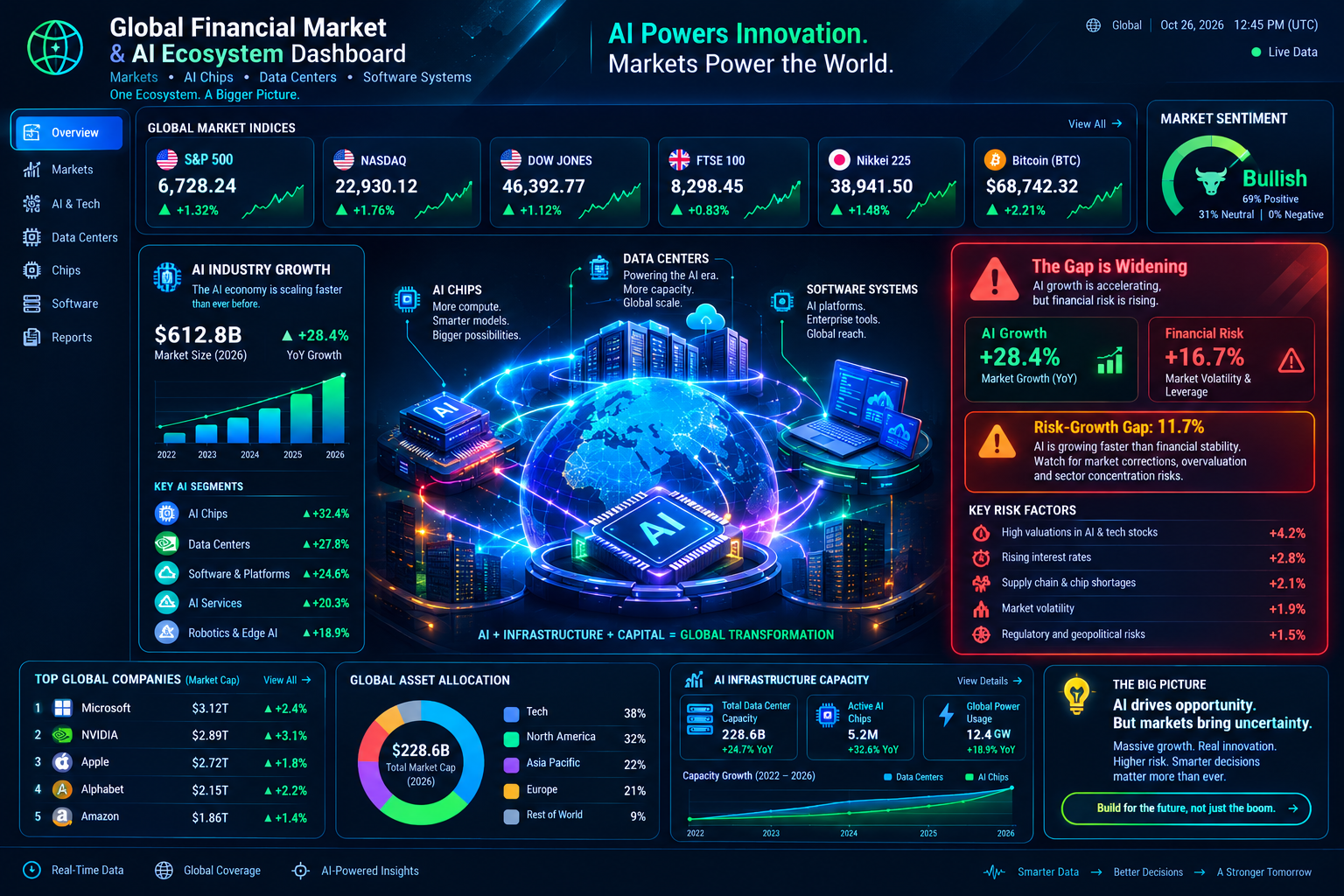
The International Monetary Fund has identified a possible AI market correction as one of the most important near-term risks to global financial stability. In its October 2026 Global Financial Stability Report, the IMF said markets remain resilient, but high expectations around artificial intelligence, concentrated investment, rising leverage, and interconnected technology companies could amplify losses if expected profits or productivity gains fail to materialize. International Monetary Fund
The practical takeaway is not that an AI crash is inevitable. It is that businesses, investors, workers, and technology leaders should separate genuine AI value from spending driven mainly by hype, debt, or fear of missing out.
What Has the IMF Confirmed?
The IMF’s report, published in October 2026, says global markets have been supported by strong corporate earnings, economic growth, and investment in AI-related companies. At the same time, it warns that financial stability risks remain elevated.
The report highlights three key factors that could trigger financial market instability:
- An AI-related correction in asset prices
- A sharp rise in sovereign bond yields
- Cyberattacks that disrupt financial systems or undermine market confidence.
For AI specifically, the IMF says a correction could become more serious if investment and profitability prove weaker or less durable than expected. The risks may be magnified by leverage, concentrated holdings, and circular financing relationships across the AI ecosystem. The NewsMarket
This is a risk assessment, not a prediction that markets will definitely collapse.
Why Is AI Investment So Important to Markets?
Huge Spending Has Raised Expectations
The AI boom has created enormous demand for chips, data centers, cloud infrastructure, electricity, networking equipment, software, and specialized services.
That investment can be economically useful. AI may improve productivity, accelerate research, support software development, and create new products. However, high spending also creates pressure to deliver equally high returns.
If companies discover that AI adoption is slower, more expensive, or less profitable than expected, investors may reduce valuations quickly.
Technology Companies Are Interconnected
AI companies do not operate in isolation. Model developers depend on cloud providers, chip companies, data-center operators, energy suppliers, and financial partners.
A weaker outlook for one part of the chain can affect the others. For example, if demand for new AI infrastructure falls, suppliers may reduce orders, lenders may reassess risk, and startups may struggle to raise additional funding.
The IMF identifies this as one possible pathway through which AI-related risks could spread across the wider financial system.
What Could an AI Market Correction Look Like?
A correction could take several forms:
Lower Technology Valuations
Shares of AI-related companies could fall if investors decide that projected earnings are too optimistic.
Slower Infrastructure Spending
Cloud providers and enterprises could delay data-center expansion, chip purchases, or large AI contracts.
Startup Funding Pressure
Early-stage AI companies may face tougher fundraising conditions, especially those without revenue, proprietary data, or a clear path to profitability.
Workforce Restructuring
Companies might reduce hiring, delay expansion, or reorganize teams if capital becomes more expensive or AI projects fail to meet business targets.
These outcomes are possible scenarios, not confirmed forecasts. The IMF’s point is that high concentration and leverage can make a market correction spread faster than a normal decline.
What Businesses Should Do Now
Measure Business Value, Not Model Hype
Organizations should ask whether an AI project improves a measurable outcome, such as:
- Lower processing costs
- Faster customer service
- Fewer errors
- Higher conversion rates
- Better forecasting
- Stronger employee productivity
- Improved research speed
A project that produces impressive demos but cannot show reliable business value should not receive unlimited spending.
Use Stage-Gated Investment
Instead of committing to a large AI rollout immediately, businesses can fund projects in stages:
- Define the business problem
- Test a limited pilot
- Measure quality and cost
- Review privacy and security risks
- Expand only if results justify the investment
This approach reduces the danger of building expensive infrastructure before the use case is proven.
Plan for Higher Costs
AI systems can create unexpected expenses through model usage, data storage, monitoring, security, and human review.
Finance and technology teams should model several scenarios, including slower adoption, higher energy prices, increased inference costs, and lower-than-expected productivity gains.
Avoid Single-Vendor Dependence
Organizations should understand how difficult it would be to move data, applications, and workflows to another provider.
Using open standards, documented interfaces, and portable data structures can reduce the impact of a vendor price increase or service disruption.
How an AI Market Correction Could Affect Workers and Job Seekers
An AI market correction would not impact all technology roles in the same way.
Companies may continue hiring for areas tied to clear revenue, reliability, security, and cost savings. Roles connected mainly to experimental projects or speculative products may face more uncertainty.
Workers can improve resilience by developing skills that remain useful across different market conditions:
- Data analysis
- Cybersecurity
- Cloud cost management
- AI evaluation
- Automation design
- Product operations
- Software reliability
- Compliance and governance
- Customer-focused problem solving
The strongest profile is often a combination of technical ability and business understanding. Employers need people who can explain not only how an AI system works, but also whether it should be deployed and how its results will be measured.
What Students Should Learn From This Trend
Students should avoid treating AI as a single guaranteed career path. The technology will remain important, but specific tools, companies, and job titles may change quickly.
A better foundation includes:
- Programming fundamentals
- Statistics and data literacy
- Model limitations
- Information security
- Communication
- Ethical decision-making
- Project evaluation
- Domain knowledge in a real industry
Building a small AI project with documented costs, failure cases, and evaluation metrics can be more valuable than simply listing many tools on a resume.
Frequently Asked Questions
Is the IMF predicting an AI crash?
The IMF does not predict an AI market crash but highlights the possibility of a market correction if investment slows or profit expectations fall short.
Why could an AI correction affect other industries?
AI investment connects chipmakers, cloud providers, data centers, software companies, lenders, and investors. A slowdown in one area could reduce demand across the wider ecosystem.
Should businesses stop investing in AI?
No. Businesses should invest selectively, use measurable pilots, control costs, and avoid assuming that every AI project will produce immediate returns.
Will an AI correction cause mass layoffs?
That is not confirmed. A correction could lead to slower hiring or restructuring in some companies, while profitable AI, security, infrastructure, and automation roles may continue to grow.
What is the safest AI investment strategy?
Focus on clear business problems, staged deployment, strong governance, portable data, and regular measurement of cost, quality, security, and productivity.
Conclusion
The IMF’s October 2026 warning is a reminder that AI is now large enough to influence financial markets, business investment, and employment decisions. The central risk is not artificial intelligence itself. It is the possibility that spending, debt, and expectations grow faster than real productivity and profits.
Businesses should treat AI as a long-term capability, not a short-term race. Workers should build adaptable skills that combine technology with judgment and measurable results. Investors and decision-makers should distinguish durable value from market enthusiasm.
Follow Tech Ketchups for practical coverage of AI, machine learning, robotics, education, gaming, layoffs, job guidance, and interview preparation. We are human and can make mistake, so please contact us if you find anything like that!