Pakistan has emerged as one of the fastest-growing crypto adoption markets in the world. But most local products focus on trading, payments, or wallets, few are attempting to solve infrastructure-level problems for the global blockchain ecosystem.
TrustVault³ is one of the exceptions.
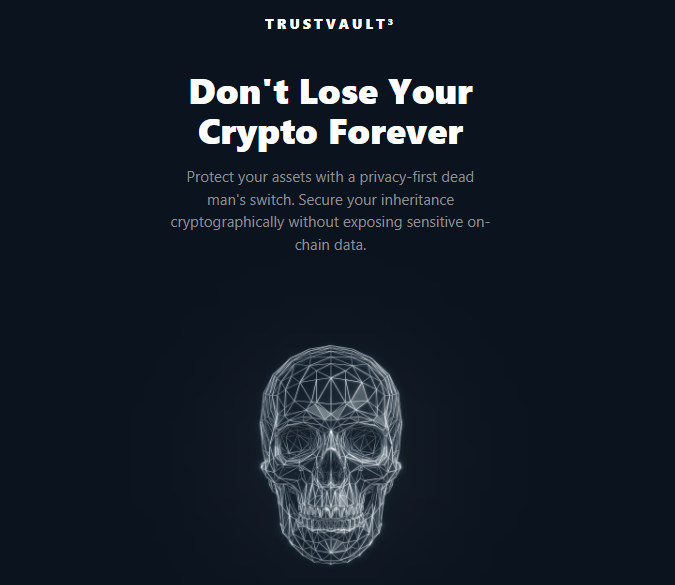
Built by a team of young Pakistani founders, TrustVault³ is a privacy-first digital asset continuity protocol tackling a problem the Web3 industry rarely talks about: what happens to your crypto when you can’t access it anymore not because of hacks or market crashes, but because of forgotten keys, inactivity, accidents, or death.
Visit and Follow
- LinkedIn: linkedin.com/company/trustvault3
- Twitter/X: x.com/TrustVault3
- Instagram: instagram.com/trust_vault3

Meet the Founder
Mr. Saad Abdullah, Blockchain Developer and Software Engineering student with a proven record of shipping production-grade decentralized applications across multiple blockchains.
The Problem Goes Beyond Inheritance
Self-custody is the foundation of crypto ownership but it comes with a quiet cost. There’s no customer support line to call if you lose your keys, and no built-in way for a family to recover assets they don’t even know exist.
If a wallet owner loses access, becomes inactive, or passes away, recovery is often close to impossible. Families frequently have no idea where a loved one’s digital assets are stored, let alone the seed phrases needed to reach them.
As adoption grows, this stops being a rare edge case and starts becoming a structural gap in the industry, one that has already left billions of dollars in crypto permanently stranded.
Building the Continuity Layer for Web3
TrustVault³’s answer is a non-custodial infrastructure layer that lets users define their own recovery and inheritance conditions, without ever handing over control of their assets to a third party.
Rather than competing with existing wallets, the protocol is designed to plug into them via APIs and SDKs letting wallets, custody platforms, and blockchain applications offer digital inheritance as a native, built-in feature instead of a separate product.
Privacy as Architecture, Not an Add-On
Digital inheritance involves inherently sensitive data: who the beneficiaries are, family relationships, recovery conditions, legal instructions, personal messages. None of that belongs permanently exposed on a public ledger.
TrustVault³ is built on privacy-preserving infrastructure that keeps this information confidential, while still allowing inheritance and recovery conditions to be verified and executed when they’re actually needed. For TrustVault³, privacy isn’t a marketing feature, it’s a core design requirement.
A Multi-Chain Vision
Digital ownership isn’t going to live on one blockchain, and TrustVault³ isn’t being built as if it will. The protocol is designed from the ground up to be multi-chain, giving wallets and applications across different ecosystems a single, unified continuity layer to build on without changing how users already custody their assets.
More Than a Product – An Ecosystem
TrustVault³’s ambitions extend well past a single inheritance tool. The long-term roadmap includes:
- Privacy-first digital inheritance
- Emergency asset recovery mechanisms
- Family continuity tools
- Secure beneficiary management
- Digital legacy storage
- Wallet integrations via APIs and SDKs
- Broader infrastructure services for blockchain ecosystems
Together, these pieces are meant to form the missing infrastructure layer for long-term digital asset ownership.
Building from Pakistan, Solving a Global Problem
TrustVault³ reflects a broader shift already underway: innovation is no longer bound by geography, and Pakistan-built teams are increasingly aiming at global infrastructure problems rather than local-only apps.
The team is currently in conversations with blockchain ecosystems and exploring partnerships to bring privacy-first asset continuity to users across multiple networks.
Building from Pakistan, Solving a Global Problem
The next phase of Web3 won’t be won purely on faster transactions or new financial products, it will be shaped by infrastructure that protects users across the entire lifecycle of digital ownership.
If TrustVault³ succeeds, it won’t just be another startup story out of Pakistan. It could become one of the country’s first meaningful contributions to global Web3 infrastructure — proof that world-class blockchain innovation doesn’t have to come from Silicon Valley.